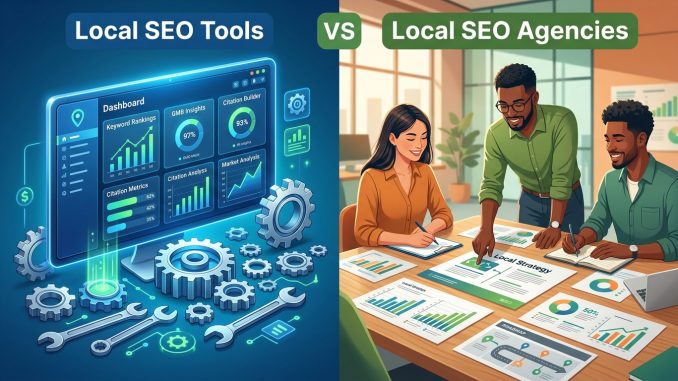
If you want your business to appear in local Google searches, you have two common options.
You can use local SEO tools and do the work yourself, or you can hire a local SEO agency to handle it for you.
Both approaches can work.
The better choice depends on your budget, experience, competition, and—perhaps most importantly—how much time you are willing to put into local SEO.
I’ve seen businesses benefit from properly managed local search, but I’ve also seen business owners spend money on tools they barely use. Having access to an expensive SEO platform doesn’t automatically improve your rankings.
So let’s look at local SEO tools vs agencies and when each option makes sense.
What Are Local SEO Tools?
Local SEO tools are software platforms that help you research, monitor, and manage your local search presence.
Depending on the tool, you may be able to:
- Research local keywords
- Track Google rankings
- Monitor competitors
- Audit your website
- Check business listings
- Monitor reviews
- Manage citations
- Track your Google Business Profile
- Find local SEO problems
- Generate reports
Some tools are free, while others require monthly subscriptions.
The biggest advantage is that you get access to data.
But there is an important limitation:
A tool can show you a problem. It doesn’t necessarily know the best way to solve it.
That’s where the difference between a tool and an experienced SEO professional becomes important.
What Does a Local SEO Agency Do?
A local SEO agency provides the people and strategy behind the tools.
Instead of simply giving you a dashboard full of information, an agency can take responsibility for implementing your local SEO strategy.
Depending on the agency, this may include:
- Google Business Profile optimization (Google)
- Local keyword research
- Competitor analysis
- Website optimization
- Local content creation
- Citation management
- Review management
- Link building
- Technical SEO
- Local ranking monitoring
- Performance reporting
- Troubleshooting Google Business Profile problems
The exact services vary from one agency to another, so you should always find out what you’re actually paying for.
Local SEO Tools vs Agencies: What’s the Difference?
The simplest way to look at it is this:
SEO tools provide information and functionality.
An SEO agency provides expertise, strategy, implementation, and ongoing management.
For example, an SEO tool might tell you that your business has inconsistent information across several directories.
That’s useful.
But someone still needs to determine:
- Which listings need to be corrected?
- Which directories actually matter?
- Is the inconsistency affecting anything?
- Which information is correct?
- What should be changed?
- Are there other problems affecting your local visibility?
The tool gives you the information.
You still have to make the decisions and do the work.
What Can You Do With Local SEO Tools?
A good local SEO tool can be extremely useful if you know how to use it.
1. Find Local Keywords
Keyword research tools can help you discover what potential customers search for.
For example, a plumber might discover searches such as:
- plumber near me
- emergency plumber
- emergency plumber in [city]
- water heater repair
- drain cleaning
- bathroom plumbing repair
This information can influence both the business’s website and Google Business Profile strategy.
2. Track Local Rankings
Rank tracking tools can show you where your business appears for specific searches.
You can monitor whether your visibility is improving or declining over time.
This can be particularly useful when you’ve recently changed your website or optimized your Google Business Profile.
3. Research Competitors
SEO tools can help you investigate competing businesses.
You may discover:
- Which keywords they target
- Where they receive links
- How their websites are structured
- How visible they are locally
- Which pages attract traffic
- How their local presence compares with yours
This can help you identify opportunities.
4. Monitor Business Listings
Some local SEO platforms allow you to monitor your business information across directories.
You might discover that your business has:
- An incorrect phone number
- An old address
- Incorrect opening hours
- Duplicate listings
- Missing listings
Keeping this information accurate is important because customers need to be able to trust what they find.
5. Monitor Reviews
Some platforms allow you to monitor reviews from multiple websites in one place.
This can save time if your business receives reviews across several platforms.
You can identify new reviews and respond to them instead of constantly checking different websites manually.
What Can an Agency Do That a Tool Can’t?
This is where the comparison becomes more interesting.
An agency can interpret the information and take action.
For example, imagine your Google Business Profile isn’t ranking well.
An SEO tool might show that your profile is underperforming.
But that’s only the beginning.
An experienced local SEO professional might investigate:
- Whether the primary category is appropriate
- Whether the business is actually relevant to the search
- How strong competing profiles are
- Whether the website supports the same local intent
- Whether the business has enough relevant reviews
- Whether the location creates a distance disadvantage
- Whether there are duplicate or conflicting listings
- Whether the profile has other problems
The important skill isn’t simply finding data.
It’s knowing what the data means and what to do next.
Local SEO Tools vs Agencies: Which Is Cheaper?
Usually, doing local SEO yourself with tools will cost less in direct expenses.
However, that doesn’t mean it’s always cheaper overall.
Consider your time.
Suppose you spend several hours every month learning SEO, researching competitors, checking rankings, fixing listings, creating content, monitoring reviews, and making changes.
That time has a value.
An agency costs more because you’re paying for someone else to provide the expertise and do the work.
So the real question isn’t simply:
“Which option costs less?”
It’s:
“Which option gives my business the better return on its investment?”
When Should You Use Local SEO Tools?
Using SEO tools yourself can make sense if:
You Have Time to Learn
Local SEO isn’t something you completely master in one afternoon.
You’ll need to understand things such as search intent, Google Business Profile optimization, local rankings, reviews, citations, website optimization, and competitors.
You Enjoy Doing the Work
Some business owners actually enjoy learning marketing and working on their websites.
If that’s you, using SEO tools can be a good option.
Your Business Is Small
A small business with one location and relatively low competition may be able to handle much of its local SEO internally.
You Have a Limited Budget
If you can’t afford an agency, learning to manage your own local SEO can be a practical starting point.
You can start with free resources and gradually invest in tools as your needs grow.
When Should You Hire a Local SEO Agency?
An agency may make more sense when you don’t have the time, knowledge, or desire to manage SEO yourself.
Consider professional help if:
You Don’t Have Time
Running a business is already demanding.
If you’re spending your evenings trying to understand why your Google Business Profile isn’t ranking, you may be better off focusing on your business while someone else handles the SEO.
You’re in a Competitive Market
If you’re competing against businesses that have invested heavily in local SEO, simply creating a profile and adding a few photos may not be enough.
You may need a more comprehensive strategy.
You Have Multiple Locations
Managing local SEO for several locations can become complicated.
Each location may require its own profile, local landing pages, reviews, content, and monitoring.
You’ve Tried SEO and Aren’t Getting Results
If you’ve spent months making changes without understanding what’s working, an experienced professional can help identify where the problem may be.
Your Google Business Profile Has Problems
Some businesses deal with issues such as:
- Suspensions
- Duplicate listings
- Incorrect locations
- Verification problems
- Ownership issues
- Missing information
These problems can become frustrating when you don’t know what caused them.
Can You Use Local SEO Tools and an Agency?
Yes—and this is actually a very common approach.
An agency may use professional SEO tools behind the scenes to:
- Research keywords
- Monitor rankings
- Analyze competitors
- Track listings
- Monitor reviews
- Create reports
The client doesn’t necessarily need to purchase every tool themselves.
The agency uses the software as part of its service.
This is why I don’t think the question should always be “tools or agency?”
Sometimes the best answer is:
tools + expertise.
My Experience With Local SEO
I’ve seen firsthand how important local visibility can be for a business.
One of my clients operated an online sales store selling a physical product. Getting local traffic was a real challenge at first, but after properly working on its local online presence, the business began attracting more local visitors, and the money coming in improved.
That experience is one reason I continue to recommend Google Business Profile to businesses.
But there’s an important lesson here.
Creating a Google Business Profile isn’t the same thing as doing local SEO.
I’ve seen businesses make basic mistakes such as choosing the wrong category, leaving important information incomplete, or trying to skip verification.
Those small decisions can create unnecessary problems.
This is also why I don’t recommend buying an SEO tool simply because someone tells you that you need one.
If you don’t know what you’re looking for, a dashboard can give you a lot of information without giving you a clear direction.
You Don’t Need Every SEO Tool
This is an opinion I think more business owners should hear.
You don’t need ten different SEO subscriptions to improve your local presence.
You need the right information and the ability to act on it.
For a small business, a combination of free Google tools, a properly managed Google Business Profile, a good website, customer reviews, and basic keyword research may be enough to get started.
As the business grows, paid tools can become more useful.
The mistake is paying for software before you understand what you’re trying to accomplish.
How Much Does Local SEO Cost?
There isn’t one standard price.
Your cost can vary depending on whether you:
- Do everything yourself
- Buy SEO software
- Hire a freelancer
- Hire an agency
- Employ an in-house SEO specialist
Your market also matters.
A small business in a low-competition location may require less work than a business competing for highly valuable searches in a major city.
So be careful when an agency gives you a package without first understanding your business, location, competitors, and goals.
Questions to Ask Before Hiring a Local SEO Agency
If you decide to hire an agency, don’t simply ask:
“How much do you charge?”
Ask what you’re actually getting.
Here are some better questions:
What will you do every month?
You should understand what the agency will actually work on.
How will you measure success?
Ask whether they’re measuring rankings, calls, website visits, leads, direction requests, sales, or other meaningful outcomes.
Will I retain ownership of my Google Business Profile?
You should maintain appropriate ownership and access to your business assets.
Do you guarantee rankings?
Be cautious with anyone promising guaranteed Google rankings.
Local search results can change, and no legitimate agency can completely control Google’s ranking systems.
What happens if I cancel?
Find out what happens to your website, listings, content, accounts, and other assets if you stop using their services.
Will I receive reports?
You should be able to see what has been done and whether the campaign is producing progress.
Local SEO Tools vs Agencies: Which Should You Choose?
Here’s a simple way to decide.
Choose local SEO tools if:
- You have time to learn.
- You enjoy working on marketing.
- Your business is relatively small.
- You have a limited budget.
- You’re comfortable implementing recommendations yourself.
Choose an agency if:
- You don’t have enough time.
- You’re unfamiliar with SEO.
- Your market is highly competitive.
- You have multiple locations.
- Your local SEO has complicated problems.
- You want someone else to manage the work.
Choose both if:
- You want professional management but also want access to data.
- You have an internal marketing team working with an external agency.
- You want to monitor performance independently.
- You want to understand what your SEO provider is doing.
Don’t Confuse Tools With Results
This is probably the most important point in this entire comparison.
Buying an SEO tool doesn’t improve your rankings.
Using the information correctly might.
The same thing applies to hiring an agency.
Hiring an agency doesn’t automatically guarantee more customers.
The agency needs to understand your market, implement the right strategy, monitor results, and adjust when necessary.
Whether you choose software, an agency, or both, you should ultimately judge the investment by what it helps your business accomplish.
Are you getting more relevant visibility?
Are people calling?
Are they visiting your website?
Are customers requesting directions?
Are you generating more leads?
Are sales increasing?
Those are much more meaningful questions than simply asking how many keywords your business ranks for.
Final Thoughts
So, local SEO tools vs agencies—which is better?
Neither is automatically better for every business.
SEO tools are useful when you have the time and knowledge to interpret the data and implement the work yourself.
An agency can be valuable when you want someone with experience to develop the strategy, manage the work, and help you avoid costly mistakes.
And for some businesses, the best approach is to use both.
If you’re just getting started, don’t feel pressured to purchase an expensive SEO platform or sign a long-term agency contract immediately.
Start with the fundamentals.
Create and verify your Google Business Profile. Make sure your business information is accurate. Choose the right category. Add useful photos and services. Build genuine reviews. Make sure your website supports your local search strategy.
Then measure what happens.
Local SEO isn’t about having the most tools. It’s about knowing what needs to be done—and actually doing it.
Frequently Asked Questions
Are local SEO tools worth it?
They can be, especially if you manage SEO yourself or need detailed data for tracking rankings, competitors, keywords, listings, and reviews. The value depends on whether you actually use the information the tool provides.
Is it better to do local SEO yourself?
For a small business with enough time and a willingness to learn, DIY local SEO can be a good starting point. As your competition, locations, or SEO needs become more complex, professional help may become worthwhile.
How do I know if I need a local SEO agency?
If you don’t have the time or knowledge to manage local SEO, are struggling with visibility, operate in a competitive market, or have complicated Google Business Profile problems, an agency may be worth considering.
Can an SEO tool replace an SEO agency?
Not completely. Tools can automate research, monitoring, and reporting, but they don’t replace human strategy, judgment, communication, or implementation.
Should a small business pay for local SEO?
It depends on the expected return. If local search generates valuable customers for your business, investing in SEO can make sense. But start by understanding what you’re paying for and how success will be measured.
Leave a Reply